Our Place
Our history, our whenua and the community we belong to.

Our School Community
Early History of the Taradale Area
About 500 years ago, long before Taradale existed and before Ngāti Kahungunu moved into our region, early Māori tribes lived at Ōtātara Pā, on the hills behind the present town.
In those days the Taradale flats were part of Te Whanganui-a-Ōrotu (the former inner harbour), which was prized by Māori for its abundant supplies of fish, shellfish, and birds. The Tūtaekurī River drained into the inner harbour at that time, and for the people of Ōtātara Pā, the river was an ideal passageway to both Te Whanganui and the interior.
Ōtātara stood as a bastion, overlooking the Heretaunga Plains and guarding the prized inner harbour. There were excellent gardens on the hills around Ōtātara and a number of springs within the pā itself.
This changed when Ngāti Kahungunu moved from Wairoa into Hawke’s Bay. The descendants of Awanuiarangi, Te Tini o Awa, Ngāti Koaupari, and Ngāti Whatumamoa, who were living at Ōtātara, abandoned the pā site. However, descendants of those early people still live in the area today. Known as Ngāti Pārau, this hapū maintains strong links to all of our local schools.
The 33-hectare pā site, one of the largest and oldest in Hawke’s Bay, is now a historic reserve managed by the Department of Conservation.
When Taradale, one of the first European settlements in the area, was established in 1886, it was flanked by a tidal swamp that was prone to regular flooding. Taradale was linked to the young town of Napier by a series of embankment bridges, but following the 1931 earthquake, the diversion of the Tūtaekurī River changed the landform drastically. The cockle beds are now long gone, replaced by the suburbs that link the two former pioneering towns.
In 1967, the Taradale Borough Council amalgamated with Napier City to better provide the services demanded by a thriving, expanding community.
Taradale Today
Taradale today is a small-town community with all the facilities and amenities of a modern city. It sits at the hub of the fifth-largest urban area in Aotearoa New Zealand — Napier, Hastings, Havelock North, and Flaxmere — while still being surrounded by wineries, orchards, lifestyle blocks, and farms that give the region its unique Hawke’s Bay flavour.
Taradale is a vibrant, family-focused community with strong whanaungatanga – people know one another, support local schools, and take pride in being part of something special.
The population of Taradale continues to grow as new housing developments attract families to the area. Recent census data shows that Taradale and Greenmeadows have grown significantly more than other parts of Napier.
Yet despite this growth, Taradale remains close-knit and community-minded. Retailers, professionals, and residents alike share the same message:
“Taradale people take care of each other – retailers provide friendly personal service, parents support the schools, and the schools support Taradale.”
Education in Taradale
Education facilities in Taradale are among some of the best in Hawke’s Bay, offering a complete learning pathway – from early childhood through to tertiary study, all within a 3-kilometre radius of the Taradale clock tower.
Education standards in Taradale are notably high. Education Review Office reports for local schools consistently highlight high achievement, positive attitudes, dedicated teachers and pride in student behaviour.
This close-knit sense of community directly benefits our tamariki. Principals across Taradale schools appreciate the strong support from parents and whānau, and the way our community values education as a shared responsibility.
At the early childhood level, families in Taradale have access to a wide range of options – including licensed child-care centres, kōhanga reo, kindergartens, playcentres, and a Rudolf Steiner kindergarten.
Primary schools include Arthur Miller, Bledisloe, Greenmeadows, Taradale Primary, Taradale Intermediate, and Reignier.
Secondary and tertiary education is provided at Taradale High School, St Joseph’s Māori Girls’ College, and Te Pūkenga | Eastern Institute of Technology (EIT).
With the development of Te Pūkenga (EIT), the education pathway in Taradale is now complete – our young people can pursue vocational or degree-level study, including teacher education, without leaving their community.
All schools in Taradale are committed to the principles of Te Tiriti o Waitangi, fostering Te Reo Māori, Tikanga Māori, and cultural competency. Across the Taradale education network, there is a shared focus on wellbeing, smooth transitions, and strong relationships – values that reflect the heart of our local schools.
Taradale Primary School
Established in 1879, Taradale Primary School epitomises all the strengths of Taradale itself:
“A close-knit community, backed by established traditions blended with modern facilities. Taradale Primary is more than 140 years old, yet it continues to offer some of the most modern, inclusive, and future-focused educational experiences available.”
At the heart of our school are our 3R values — Respect, Relationships, and Responsibility — guiding the way we learn, connect, and grow together.
Cultural
Te Pepeha o Ngāti Pārau
| Te reo Māori | English |
|---|---|
| Ko Ōtātara Pā te maunga | Ōtātara Pā is the mountain |
| Ko Tūtaekurī te awa | Tūtaekurī is the river |
| Ko Te Whanganui a Orotū te moana | Te Whanganui a Ōrotu is the significant body of water |
| Ko Tākitimu te waka | Tākitimu is the waka |
| Ko Waiohiki te marae | Waiohiki is the meeting place |
| Ko Hau Te Ana Nui te wharenui | Hau te Ana Nui is the meeting house |
| Ko Ngāti Pārau te hapū | Ngāti Pārau is the subtribe |
| Ko Ngāti Kahungunu te iwi | Ngāti Kahungunu is the tribe |
| Ko Tāreha Te Moananui te tangata | Tāreha Te Moananui is the eponymous ancestor |
At Taradale Primary School we share the pepeha of our local hapū as a sign of respect and acknowledgement of our growing partnership. This connection grounds us in the history, whenua and relationships that shape our kura. We are honoured to have been gifted Moremore, from the pūrākau of Pania of the Reef, and this is proudly displayed around our school as a reminder of our local identity and connections.
We value the diverse cultures, languages and backgrounds of our tamariki and whānau. We want every child to feel connected to their language, culture and identity, and we honour the unique strengths they bring. Guided by our commitment to giving genuine effect to Te Tiriti o Waitangi, we work alongside whānau to ensure all voices are recognised, respected and supported to thrive.
Cultural connectedness is woven throughout daily life at our kura. It can be seen in our shared spaces, heard in the voices of our tamariki and felt in the warm relationships across our community. Examples include welcoming manuhiri with a mihi whakatau, sharing waiata and pepeha in assemblies, celebrating language weeks, preparing and cooking hāngī in our school hāngī cookers, kapa haka and learning our local pūrākau.
He aha te mea nui o te ao? He tangata! He tangata! He tangata!
What is the most important thing in the world? It is people! It is people! It is people!
Library
At Taradale Primary School, we are incredibly proud of our vibrant and much-loved library – the heart of our school and a place where imagination and curiosity thrive.
Thanks to the generous support of our BOT, and the passion and expertise of our Librarian Extraordinaire, Claire Smith, our library continues to flourish at a time when many kura are sadly losing theirs. At TPS, we remain deeply committed to keeping our tamariki’s noses in books and their minds full of wonder.
Our librarians, Kaitiaki o ngā pukapuka – a team of dedicated tamariki – are trained in the ways of the library. Currently, we have around 30 enthusiastic librarians who work tirelessly to make sure the space is welcoming, well-organised, and full of fun. During lunchtimes, the library hums with stories, laughter, Tuakana–Teina relationships, and new adventures. It’s a true hub of whakawhanaungatanga, where creativity, curiosity, and collaboration come together.
Each year, our library hosts a range of beloved events that celebrate reading and bring our community together — including the Scholastic Book Fair, Milo and Marshmallow Night, and our ever-popular Book Week. We also run a Summer Reading Programme which gives students the chance to take home a special selection of books to enjoy over the holidays, keeping their reading skills sharp and their imaginations buzzing. Because there’s nothing better than getting lost in a good book on a summer’s day!
Our library displays are constantly evolving, reflecting current learning themes, different cultures and inspiring a lifelong love of reading. Claire and Ms Stevenson work closely with teachers to ensure the library remains relevant, engaging, and inclusive – supporting the needs of our tamariki, kaimahi (staff) and whānau alike.
We even have a special collection of books available for parents to borrow, so everyone in the TPS community can share in the joy of reading.
“Libraries store the energy that fuels the imagination. They open up windows to the world and inspire us to explore and achieve…” – Daniel Pink
Green Family Taradale Pool
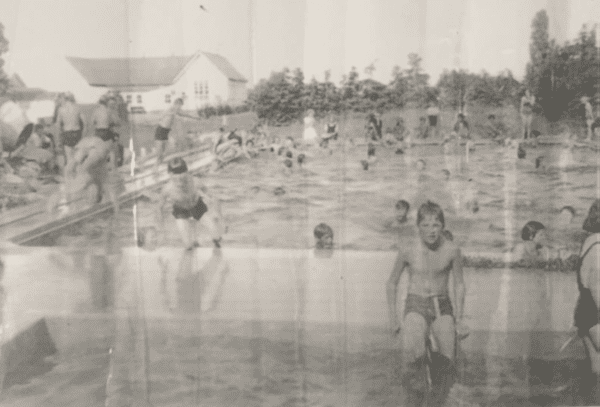
History – Green Family Taradale Pool
*Used with permission from Dolphin Academy
(Formerly known as Taradale Community Pool or ‘Greendale’ Pool)
The journey to get here has been long and hard, but it has been incredibly heart-warming to see the Community pull together to ensure such an important asset remains in operation.
The original pool was built using voluntary labour during WWII, after the idea was initially mooted in 1939 at a public meeting called by the Chairman of the School Committee. Building started in 1944, and cost the school just over 900 pounds. This money was raised through fundraising by the community and as stated in the 1954 Jubilee magazine, the community’s efforts were “particularly creditable in view of the fact that so much of the work – all of it, in fact – and the raising of the money, has been due to the energetic and civic-minded citizens associated with Taradale”. The project took three years to complete, and in 1947 the responsibility for cleaning, filling and chlorinating the pool was passed over to the School Committee.
In 1953, the School Committee decided to fundraise further and complete the baths by providing dressing sheds, concrete the surround and provide seating. Funds were raised through events organised by the committee, with the School’s 1953 “Miss Taradale” competition raising the significant sum of 1280 pounds. Most remarkable was the efforts of the community to partake in working bees to get the work completed.
Greendale Swim Club was set up in late 1957 on the grounds of the Taradale Primary School by a coach, Tom Harvey (a teacher at the School), a committee of dedicated parents and a number of focused swimmers. The members of the new club were a breakaway group from the Napier Swimming Club which operated out of the old Marine Parade Pool.
During the 1980s, the current walls and roof were erected, also funded through fundraising by the local community.
Throughout subsequent years this facility has been improved by the Club – an extension from 18m to 25m pool length, covering the pool, a new filtration plant, seating, solar water heating, new changing facilities and heat pumps. The pool was, until December 2016, operated and maintained by the Club under a long-term lease with Taradale Primary School.
In December 2016, the pool on the grounds of Taradale Primary School was closed due to the building not meeting the revised building standards. Due to the pool closure, the Competitive Squads found a new home at the Clive War Memorial Pool. Unfortunately, no lane space could be found anywhere in Hawke’s Bay for Learn to Swim and Swimming in Schools and so these programmes were halted.
Rather than see this pool closed, a group of dedicated volunteers got together and formed a plan. The Taradale Community Pool Trust (TCPT) was formed. The objectives of the Trust were to complete a business case and present to the MOE, get this approved and then lead the roof replacement project. The Trust’s role at the completion of the project will be to manage the asset.
In June 2020 the Trust called for expressions of interest for operators to run the pool. Dolphin Academy Limited was appointed in November 2020 as the new Operators with an intended opening date of February 2021.
Ōtātara Kāhui Ako
Who are we?
We are a group of schools and early childhood education providers in the wider Taradale (Ōtātara) area of Napier.
We share the vision of working collaboratively to raise learner wellbeing and achievement. We believe that we can address learning challenges better together than separately, whilst still retaining each school and centre’s unique character and style.
We have agreed that learners and learning are at the centre of all we do, and our collaboration is for their benefit, generating the best possible education for the ākonga of our area. Our shared whakataukī is:
Nā tō rourou, nā taku rourou ka ora ai te iwi. With your food basket and my food basket the people will thrive.
The school’s who have joined the Ōtātara Kāhui Ako are:
- Arthur Miller School
- Bledisloe School
- Greenmeadows School
- Parkside Christian Seventh Day Adventist School (pending)
- Pātoka School
- Puketapu School
- Reignier Catholic School
- Taradale High School
- Taradale Intermediate School
- Taradale Primary School
The early childhood centres who have joined the Ōtātara Kāhui Ako are:
- Active Explorers Greenmeadows
- Best Start Greenmeadows
- Best Start Montessori Greenmeadows
- Best Start Taradale
- Bright Futures Hawke’s Bay
- The Den: Discover Education in Nature
- Dot Kids Early Learning Centre Nursery
- Dot Kids Early Learning Centre Preschool
- Footsteps Adventist Preschool
- Greenmeadows Kindergarten
- Happy Days Child Care Centre
- Little Wonders Greenmeadows
- Ōtātara Children’s Centre
- Patoka Rural Kindergarten
- Pirimai Kindergarten
- Puketapu Community Early Childhood Educare
- Taradale East Kindergarten
- Taradale Kindergarten
- Te Kōhanga Reo o Waiōhiki
We seek to establish positive transitions between different education settings (ECE, Primary secondary and tertiary education) for students as they move through our schooling optimising their well-being and learning.
We believe that we share the responsibility of supporting quality education in one another’s schools, thereby seeking outcomes that are the best for the whole community of schools. Through developing collaborative relationships with partners such as ECE providers and the Eastern Institute of Technology we can all better access available professional services and community support, including learning from and with iwi and hapū.
Achievement Challenges
We have identified three common areas of practice (achievement challenges) which we recognise the need to collaboratively develop as teachers in order to benefit the children of Ōtātara. These are: Cultural Connectedness, Hauora/Wellbeing and Preparedness to Learn.
Cultural Connectedness. Increase the proportion of students who report that they feel strong connections to their language, culture and identity, and that their cultural identities are valued and respected across our Kāhui Ako. Examining in particular the Aotearoa New Zealand Histories curriculum, Te Tiriti o Waitangi and the development of teacher skills in Te Reo Māori. Across Community lead teacher for Cultural Connectiveness: Keriana McKee keriana@taradaleint.school.nz
Hauora/Wellbeing. Increase the proportion of students who report positively against our four well-being indicators: Taha hinengaro (ideas related to mental and emotional wellbeing), Taha wairua (ideas related to spiritual wellbeing), Taha tinana (ideas related to physical wellbeing), and Taha whānau (ideas related to social wellbeing). We are looking to increase resilience in our young people, and reduce anxiety levels in the classroom/school. Across Community lead teacher for Hauora/Wellbeing: Raelene Hill raeh@taraprimary.school.nz
Preparedness to Learn (the early years). Increase the proportion of students who report they have the dispositions required to develop ‘capabilities for living and lifelong learning’ from early childhood to primary school. In particular oral language/communication development, structured literacy and development of the foundation skills for learning. Sharing of good practice between teachers of special needs and early years teachers is also being undertaken. Across Community lead teacher for Preparedness to Learn (the early years): Kara-Leigh Jones kjones@reignier.school.nz
Preparedness to Learn (the older years). Increase the proportion of students who report they have the dispositions required to develop ‘capabilities for living and lifelong learning’ from primary to tertiary education. Examining in particular the transition process from primary schools to intermediate and intermediate to secondary; the development of student agency and literacy teaching. Across Community lead teacher for Preparedness to Learn (the older years): Vinka Donkin vinkad@taradaleint.school.nz
Please get in touch with one of the across community teachers or Ōtātara Kāhui Ako lead Greig Mercer (greig.mercer@gmail.com) if you would like to know more or would like to support the Kāhui.